
Product Workflow Validation
A traceable lead-to-cash workflow with Taleef CRM
Client identity is kept confidential at their request.
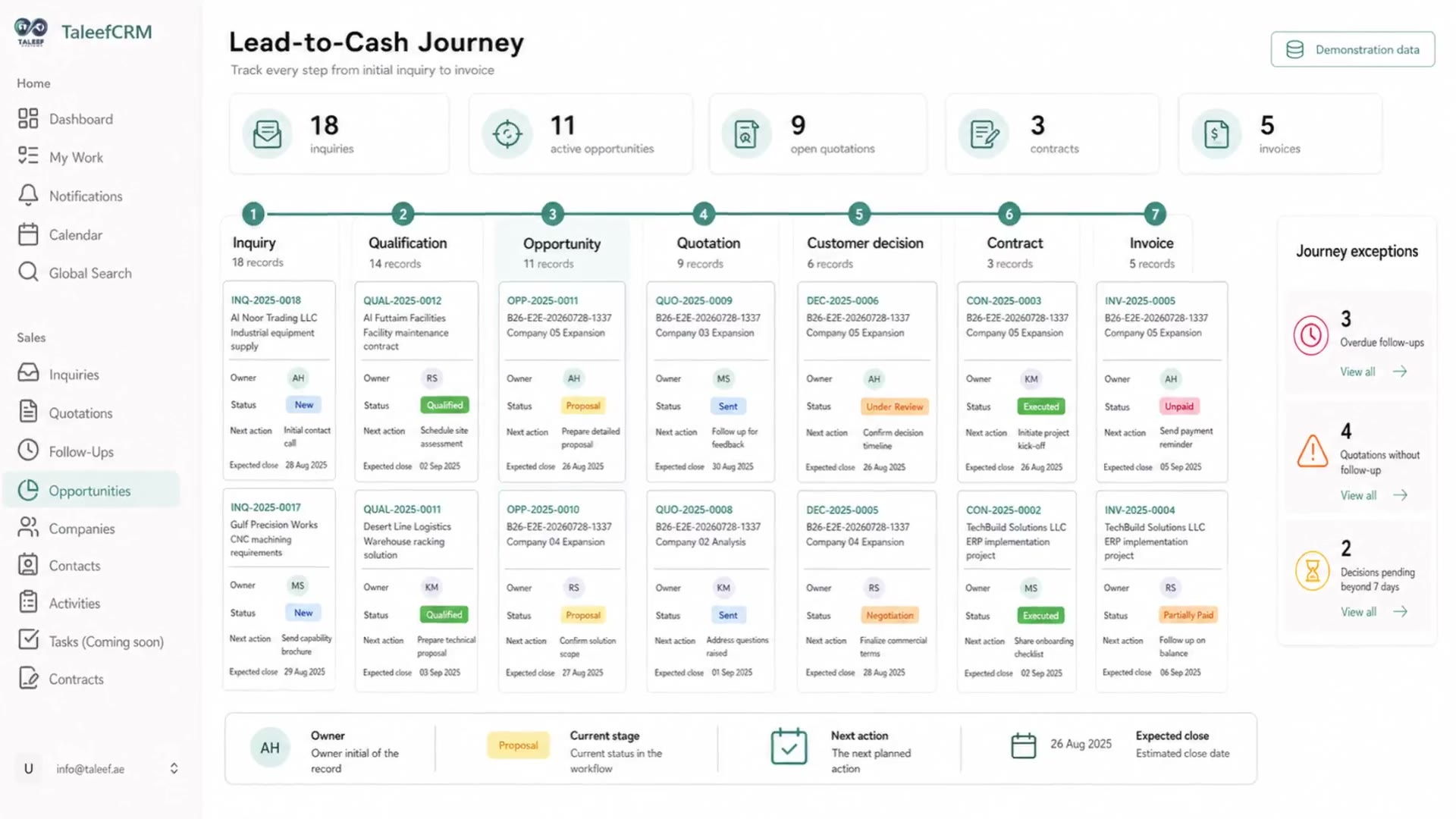
Evidence disclosure: This study documents Taleef CRM functionality exercised in a controlled demonstration environment. All people, companies, values and records shown in the media are demonstration data. This is not a customer implementation and does not report customer business outcomes.
The challenge
The operational challenge
Growing businesses frequently manage enquiries, quotations, follow-ups, contracts and invoices across disconnected spreadsheets, inboxes and applications. The resulting problem is larger than administrative overhead: teams can lose visibility into ownership, next actions, commercial status and the history behind each decision.
A fragmented lead-to-cash process commonly creates four risks: enquiries can remain unassigned or receive inconsistent follow-up; management cannot reliably identify the next action on an opportunity; commercial documents become disconnected from the originating customer record; and reporting depends on manually reconciling information from multiple systems.
The validation asked a practical question: can one configured workflow make responsibility, stage and next action visible throughout the commercial journey?
Our approach
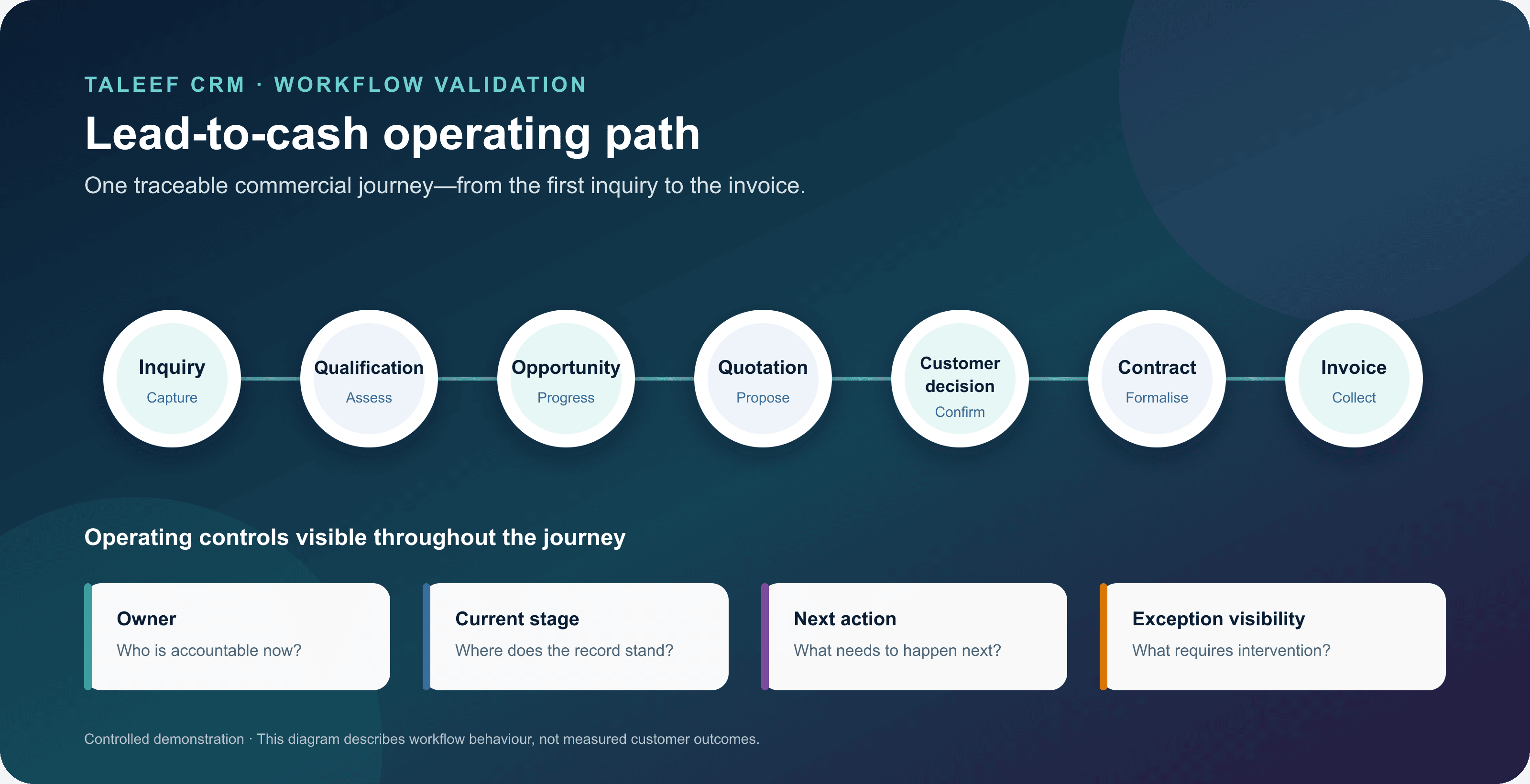
The validated workflow
Enquiry capture and qualification: new enquiries enter a defined workflow where their status, ownership and qualification information can be recorded.
Ownership and next-action visibility: commercial records can be associated with a responsible owner and a defined next step, giving teams a consistent place to identify work requiring attention.
Opportunity progression: qualified enquiries move through a structured commercial pipeline rather than remaining in disconnected messages or personal spreadsheets.
Commercial-document continuity: quotation, customer-decision, contract and invoice stages remain connected to the broader customer journey, giving authorised users a clearer operating history.
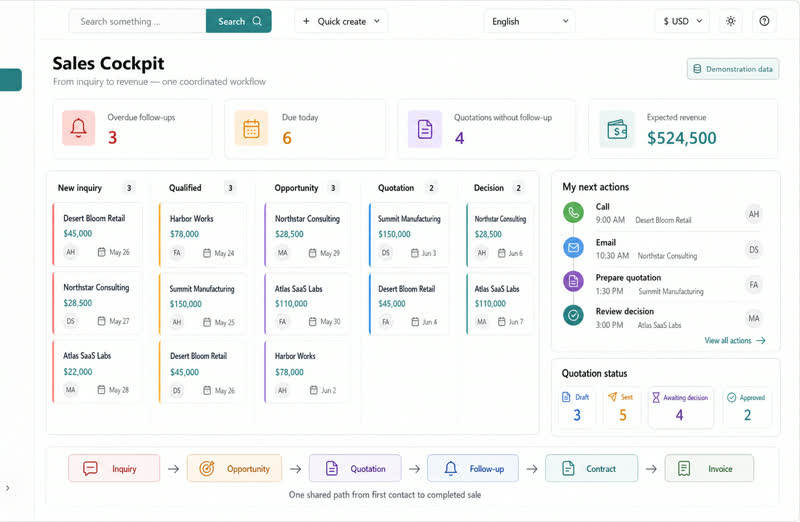
Management visibility: dashboards and structured records consolidate pipeline stage, responsibility, next actions and workflow exceptions into a shared operating view.
Outcome
What the validation established
The controlled validation demonstrated that Taleef CRM can be configured to support a consistent enquiry-to-invoice workflow, visible ownership and next actions, structured commercial-stage transitions, connected customer and transaction records, shared operational visibility, and repeatable workflow acceptance testing before deployment.
These findings establish product behaviour. They do not establish customer adoption, revenue improvement, conversion uplift or time savings.
A production implementation should additionally validate user roles and access boundaries, data-retention and audit requirements, legacy-record quality and migration reconciliation, required integrations and error handling, reporting definitions and data stewardship, user-acceptance criteria and sign-off, and backup, recovery and support procedures. Taleef configures and supports the platform directly, adapting the implementation around the organisation's operating model rather than requiring every business to adopt an identical process.
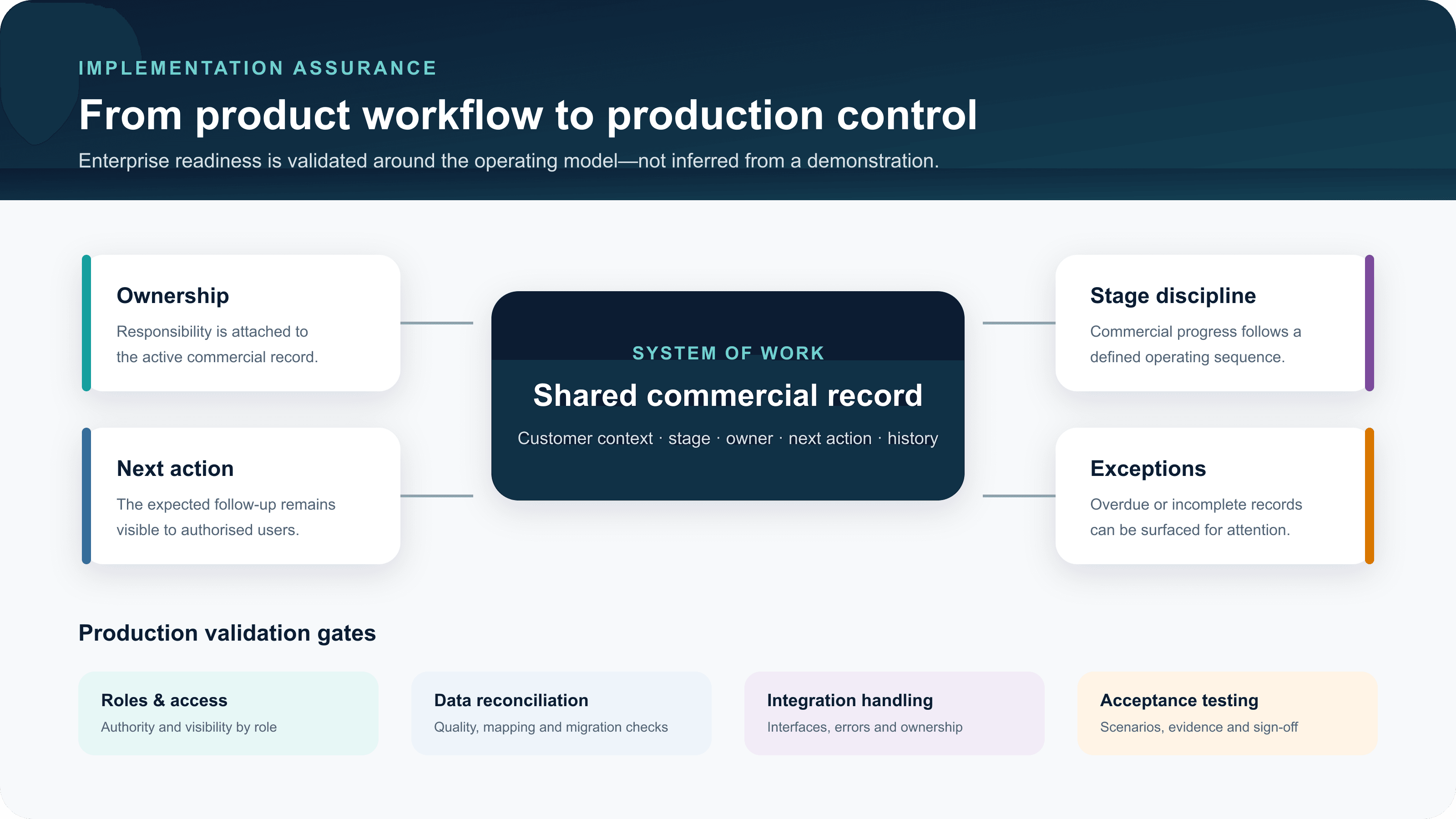
This study does not claim a particular increase in conversion, reduction in response time, percentage of completed follow-ups or number of migrated accounts. Those figures require an authorised production dataset, a defined measurement period and an approved calculation method.
Is this workflow relevant to your organisation?
Taleef can review your existing lead-to-cash process, identify control gaps and define a production validation plan around your users, data and integration requirements.